Rye vs Greenwich: Which Coastal Town Is Right for Your Family?
Rye vs Greenwich: two beautiful Long Island Sound towns, one in New York and one in Connecticut. Both offer top schools, coastal living, and a quick ride to Manhattan. The comparison below covers property taxes, walkability, and the rest of the trade-offs.
Quick Comparison
| Factor | Rye, NY | Greenwich, CT |
|---|---|---|
| Distance to NYC | 24.1 miles | 28 miles |
| Train Commute | ~40-50 min (peak express) | ~41-48 min (express) |
| Metro-North Stations | 1 station | 4 stations |
| Population | ~16,429 | ~63,500 |
| Median Home Price | ~$2.2M (Redfin) | ~$2.0–2.2M mixed / $3.95M SF |
| Effective Property Tax | ~1.17% of market value | ~0.71% of market value |
| Median Annual Tax Bill | ~$22,698 | ~$14,168 (on $2M home) |
| Community Feel | Intimate, walkable coastal city | Larger, varied villages |
| High School Size | ~895 students | ~2,620 students |
Location and Commute

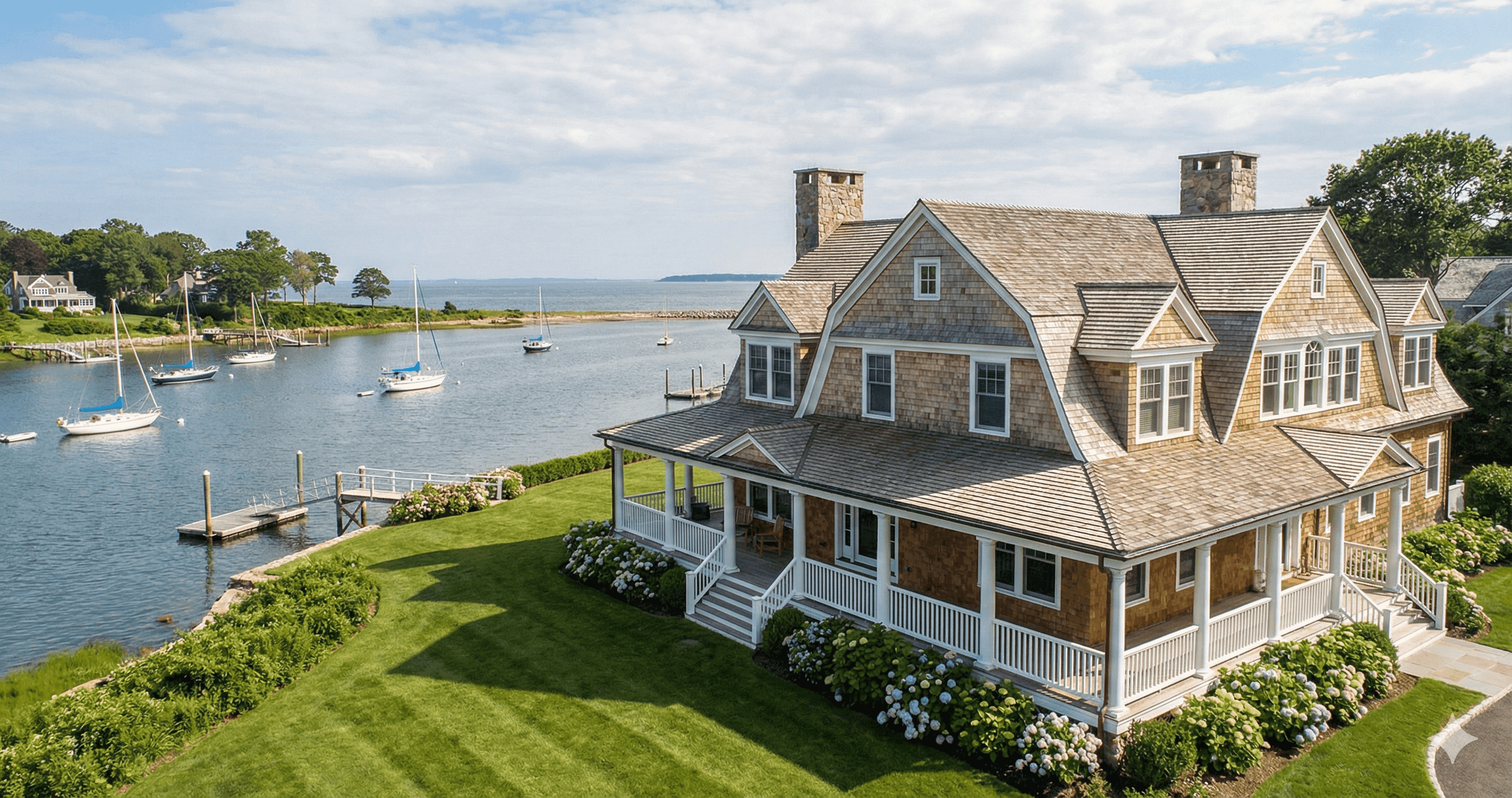
Rye vs Greenwich: both towns sit right on the Long Island Sound, so you get the same shoreline DNA, waterfront access, sailing culture, and salt-air mornings. The big difference is which side of the state line you land on. Rye is in Westchester County, New York, about 24.1 miles from Grand Central. Greenwich is just across the border in Fairfield County, Connecticut, roughly 28 miles out.
Both towns ride the Metro-North New Haven Line. Rye has a single station, with peak express trains reaching Grand Central in roughly 40 to 50 minutes. Greenwich spreads four stations across town (Greenwich, Cos Cob, Riverside, and Old Greenwich), with express trains landing around 41 to 48 minutes.
On paper, Rye is slightly closer to Manhattan, and for a commuter living near the Rye station that edge is real. But Greenwich's four stations change the calculus. With platforms scattered across town, most Greenwich homes sit within a short walk or quick drive of a train, while in Rye almost everyone funnels through that one station.
For drivers, both towns connect to I-95, and Greenwich also taps the Merritt Parkway (Route 15). Rye puts you near the cross-county corridors of Westchester and a short hop to White Plains. Greenwich sits closer to Stamford's corporate offices and dining.
Rye wins on raw distance and a one-seat ride that's a touch shorter from the station. Greenwich wins on flexibility, with four stations meaning your specific neighborhood probably has a platform nearby. If you live near Rye's station, the commute edge is yours. If you want options across town, Greenwich delivers.
Door-to-GCT, not the brochure
Express to Grand Central, typical weekday
These are typical express times to Grand Central. Locals, a drive to the station, and a subway to Hudson Yards or FiDi add 15–40 minutes. Ride it twice before you bid.
One station. New Haven Line, NY taxes.
Four stations. Almost the same clock, lower tax bill.
Neighborhoods and Character
Rye, NY Neighborhoods
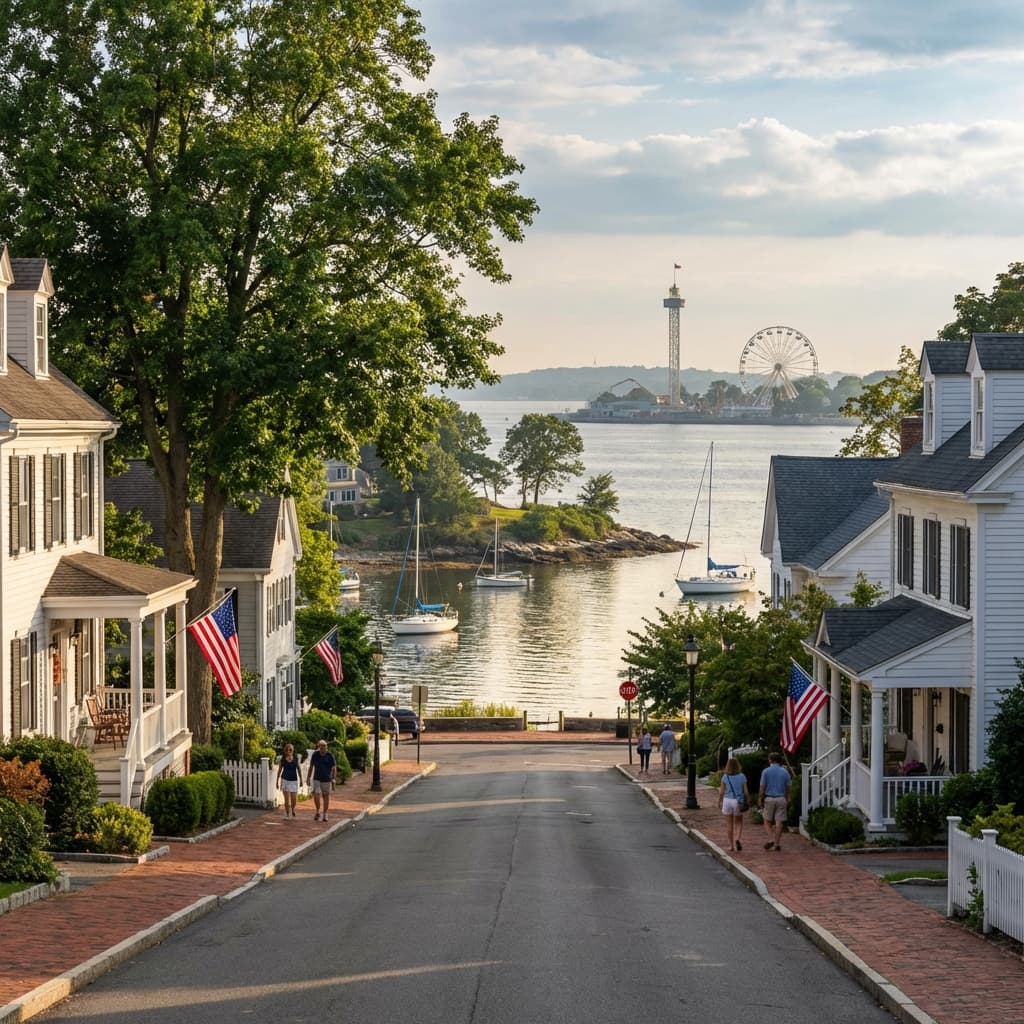
Rye reads as a small, tight-knit, nautical city. It's compact enough that you can know your barista and your harbormaster, with a genuinely walkable downtown anchored by Purchase Street. Playland Park, the historic seaside amusement park, gives the town an instantly recognizable landmark on the Sound.
Greenhaven
Waterfront estates with private docks. The premium pocket of Rye for boating families who want the Sound at their back door.
Milton
Close to Rye's beaches and the American Yacht Club. Coastal living with a strong sailing and club culture.
Downtown / City Center
Walkable Purchase Street shops and dining. The heart of Rye's small-city, stroll-everywhere appeal.
Near Playland
Family-friendly streets close to Playland Park and the beach, with that classic Long Island Sound town feel.
Greenwich, CT Neighborhoods
Greenwich is far larger and more varied. Where Rye is one cohesive coastal city, Greenwich is a collection of distinct villages, from beachy and walkable to gated and grand to wooded and private. That range is its signature advantage.
Old Greenwich & Riverside
Coastal, walkable villages with beaches and their own train stations. The closest Greenwich feel to Rye's shoreline charm.
Cos Cob
More affordable village feel with a train station and local shops. A common entry point into Greenwich.
Belle Haven
Gated luxury enclave with waterfront estates and a private club. Greenwich's ultra-premium address.
Backcountry
Sprawling estates on wooded acreage. Privacy, space, and grandeur away from the shoreline.
Housing and Real Estate
The mixed medians sit close together. Rye's overall median is about $2.2 million. Greenwich's mixed number (condos plus houses) still prints around $2.0 to $2.2 million. If you are buying a house, Greenwich's August 2026 single-family median was $3.95M with 17 days on market. Compare the house you will actually live in, then look at the tax bill.
The median trap
A $2M mixed median is not a $2M house
Town-wide medians mix condos, co-ops, and houses. Greenwich's mixed number still prints around $2M, which is why older roundups look even with Rye or Scarsdale. If you are buying a house, use the house number.
Mixed / overall
~$2.0–2.2M
Condos pull this down. August condo/co-op median was $1.16M.
Single-family, Aug 2026
$3.95M
GAR MLS. 17 days on market, 83 listings, 103.6% of list.
What differs is selection. Rye is a smaller, more uniformly coastal and high-end market. Inventory is tight, the housing stock leans classic, and waterfront pockets like Greenhaven command real premiums. The compact footprint is part of the appeal, but it also means fewer listings and a more competitive hunt.
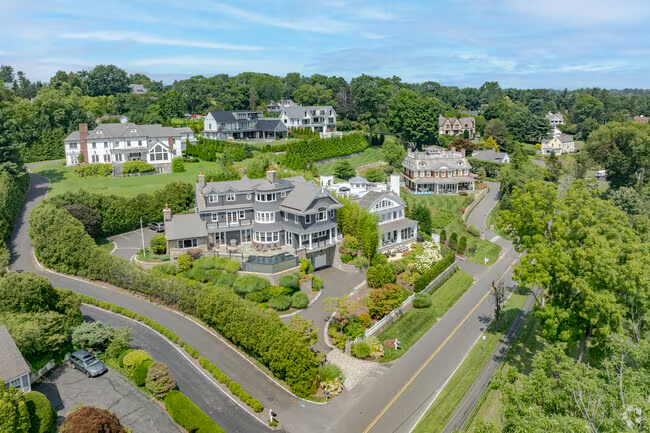
Greenwich offers far more variety because it's a much larger town. You can move from a walkable Old Greenwich cottage to a Cos Cob value buy to a gated Belle Haven estate to a backcountry compound, all within the same town lines. For buyers who want choices, that breadth is hard to match.
Both are wealthy, blue-chip markets that hold value. Rye gives you a tighter, more boutique inventory in a charming coastal city. Greenwich gives you scale and range. Your pick comes down to whether you value the intimacy of a small market or the optionality of a big one.
Schools and Education
Both towns send students to excellent public high schools, but the experience differs sharply by scale. Rye High School, part of the Rye City School District, enrolls only about 895 students. It posts a 98% graduation rate, an A+ Niche grade, and a national US News rank near #266 (about #37 in New York). Rye High is a separate district from Rye Neck High School, so this page is about the City of Rye's school.
The standout Rye stat is AP participation, around 93%, which is exceptionally high. In a small high school where nearly everyone takes Advanced Placement coursework, the academic intensity and peer expectations run hot. For motivated students who thrive on a college-prep culture, that's a powerful environment.
Greenwich High School is a different animal in scale, with about 2,620 students. It posts a 94% graduation rate, offers 30 AP courses, earns an A+ Niche grade, and ranks #9 in Connecticut on US News. The large student body means a deep menu of courses, electives, sports, and arts programs that a small school simply can't field.
The choice mirrors the towns themselves. Rye High is small and intense, with near-universal AP participation and a tight community. Greenwich High is large and broad, with more course variety and program depth. Both are top-tier; the question is whether your child wants the intimacy of a small school or the range of a big one.
Property Taxes: The NY vs CT Gap
This is where Rye and Greenwich genuinely diverge, and it's the single biggest financial factor in the decision. Even with similar home prices, the New York versus Connecticut tax structures produce very different annual bills.
Rye sits in Westchester County, New York, one of the highest property tax regions in the country. The effective rate runs about 1.17% of market value, and the median annual tax bill lands near $22,698. That's a large, recurring expense baked into homeownership, year after year, regardless of how the market moves.
Greenwich works differently. Connecticut towns assess homes at 70% of market value, then apply a mill rate. Greenwich's FY2026-27 mill rate is 10.12, which translates to about 0.71% of actual market value once you account for that 70% assessment. On a $2 million home, that's about $14,168 a year.
Like-for-like, not medians
Annual tax on the same $2 million home
Connecticut towns assess at 70% of market, then multiply by the mill rate. New York towns use an effective rate on market value. Same $2M house, different bill.
FY2026-27. ~0.71% of market.
~1.17% of market. Same $2M house, about $9,200 more per year.
Stack them side by side and the gap is striking. A Rye family near the median pays roughly $22,700 a year, while a Greenwich owner of a $2 million home pays about $14,168. That's nearly $6,000 in annual savings on the Greenwich side, and the difference compounds over a decade of ownership into real money.
None of this makes Rye a bad value. You're paying for an intimate, walkable, high-performing coastal city. But if your decision comes down to dollars, Greenwich's lower effective property tax burden is one of the clearest advantages either town holds.
Sources: Westchester County / Rye assessment data (effective ~1.17%, median ~$22,698); Town of Greenwich Assessor, FY2025-26 mill rate 10.12 at 70% assessment.
Let's Chat About Your Move
Tell me whether you lean toward Rye's walkable, intimate coast or Greenwich's larger range of villages, and I'll send you a curated list of homes in the town that fits you best.
Who Each Town Is Best For
Choose Rye if:
- You want an intimate, tight-knit coastal city where daily life feels close-knit
- You value a genuinely walkable downtown along Purchase Street
- You prefer a small, high-performing high school with near-universal AP participation
- You want the slightly shorter distance to Grand Central from a single, central station
- You love nautical culture, beaches, yacht clubs, and landmarks like Playland Park
- You're comfortable with the higher New York / Westchester property tax burden
Choose Greenwich if:
- You want a lower effective property tax burden (about $14,168 on a $2M home)
- You value four train stations and the commuting flexibility they bring
- You want housing variety, from coastal villages to gated estates to backcountry acreage
- You prefer a larger town with more amenities, dining, and neighborhood choices
- You want a large high school with deep course, sports, and arts offerings
- You like the idea of finding very different lifestyles within one town
Priority Scoring Worksheet
Rate each factor from 1-5 for importance, then see which town scores higher for your priorities.
How to use: Rate each factor 1-5 based on importance to you. Then compare which town better matches your priorities. For example, if property tax savings are a 5 and walkability is a 2, Greenwich likely scores higher for you.
Get personalized recommendationsReady to Explore Your Options?
Not sure which town fits your family?
I've helped families weigh Rye's walkable, intimate coast against Greenwich's larger range of villages and lower tax burden. Let's talk through which town aligns with your priorities, budget, and lifestyle.
Book Your Free ConsultationFrequently Asked Questions
Is Rye or Greenwich closer to NYC?
Rye is slightly closer at about 24.1 miles to Grand Central, versus roughly 28 miles for Greenwich. Both sit on the Metro-North New Haven Line. Peak express trains from Rye run about 40 to 50 minutes, while Greenwich express trains take about 41 to 48 minutes. The bigger difference is station count: Rye has one station, while Greenwich has four (Greenwich, Cos Cob, Riverside, and Old Greenwich).
Are property taxes lower in Rye or Greenwich?
Greenwich is meaningfully cheaper on property taxes. Rye's effective rate runs about 1.17% of market value, with a median annual bill near $22,698 (typical for Westchester County, NY). Greenwich's 2025-26 mill rate of 10.12 works out to roughly 0.71% of market value because homes are assessed at 70%. On a $2 million home that's about $14,168 a year in Greenwich. The NY versus CT tax gap is the single biggest financial difference between the two towns.
How do Rye and Greenwich schools compare?
Both are excellent but differ in scale. Rye High School (Rye City School District) is small, with about 895 students, a 98% graduation rate, an A+ Niche grade, and roughly 93% AP participation, which is unusually high. It ranks around #266 nationally and #37 in New York on US News. Greenwich High School is much larger, with about 2,620 students, a 94% graduation rate, 30 AP courses, an A+ Niche grade, and a #9 ranking in Connecticut. Note that Rye High is separate from Rye Neck High School, which is a different district.
What are the best neighborhoods in Rye, NY?
Signature Rye areas include Greenhaven (waterfront estates with private docks), Milton (close to the beaches and the American Yacht Club), and Downtown / City Center, where Purchase Street offers walkable shops and dining. Playland Park is a beloved local landmark on the Sound.
What are the best neighborhoods in Greenwich, CT?
Top Greenwich neighborhoods include Old Greenwich and Riverside (coastal, walkable, with beaches and train stations), Cos Cob (more affordable with a village feel), Belle Haven (a gated luxury enclave), and Backcountry (large estates on wooded acreage). The variety lets buyers find very different lifestyles within one town.
How do home prices compare in Rye versus Greenwich?
Mixed medians can look close. Rye's overall median is about $2.2 million. Greenwich's mixed number still prints around $2.0 to $2.2 million because condos pull it down. Greenwich's August 2026 single-family median was $3.95M. Compare the house you will actually buy, then the tax bill: about $14,168 in Greenwich versus about $23,400 in Rye on the same $2M home.
Which town has a more walkable downtown, Rye or Greenwich?
Rye has the more intimate, walkable downtown. Purchase Street packs shops, restaurants, and services into a compact, strollable City Center, and the whole town is small enough that daily life feels close-knit. Greenwich Avenue is a larger and more upscale shopping street, but Greenwich is a far bigger town spread across several distinct villages, so the small-downtown feel is concentrated in pockets rather than the whole community.
Which town is better for families, Rye or Greenwich?
Both are outstanding for families. Choose Rye for an intimate, tight-knit coastal city with a walkable downtown, a small high-performing high school, very high AP participation, and a slightly shorter distance to Grand Central. Choose Greenwich for a larger town with four train stations, more housing variety, lower property taxes, and a wider range of neighborhoods from coastal villages to backcountry estates. The trade-off is intimacy and walkability versus scale and a lighter tax burden.
Last updated: June 2026. Market data from Redfin, Westchester County and Rye assessment records, and the Town of Greenwich Assessor's Office.
Related Guides
Scarsdale vs Greenwich
Compare another top Westchester town with Greenwich on taxes, schools, and commute.
Greenwich vs Darien
See how Greenwich stacks up against neighboring Darien, CT.
Best Suburbs Near NYC
Compare all top suburbs including Greenwich, Rye, Darien, and more.
Moving to Greenwich
A complete relocation guide to settling into Greenwich, CT.
Cost of Living in Greenwich CT
Full breakdown of property taxes, housing, childcare, and daily expenses.
Greenwich Neighborhoods
Explore Old Greenwich, Riverside, Cos Cob, Belle Haven and more.